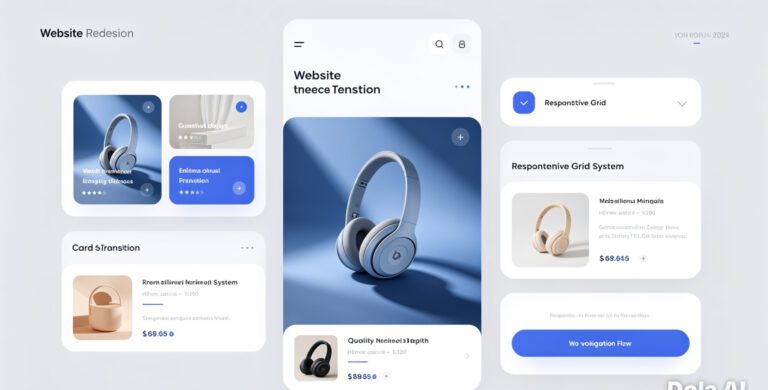
Things move fast in the digital world. Blink and there’s a new app, a fresh aesthetic, or a user habit we somehow never saw coming. When it comes to website design in 2025, though, it’s not just rapid. It’s revolutionary. Whether you’re a creative agency, a brand-focused business in Devon, or a freelancer navigating a rising tide of trends, what’s happening in design right now is reshaping how we experience the web entirely.
So, what’s really changing? A lot. But five standout trends are transforming more than just style. They’re reinventing function, feel, and the very fabric of the user journey.
AI and Automation: Taking on the Heavy Lifting (But Not the Creativity)
Let’s start where the conversation inevitably goes these days. Artificial intelligence. AI in web design isn’t some vague idea anymore. It’s happening, and it’s reshaping how we build, test, and tweak digital experiences.
Take Figma’s AI tools, for example. I’ve worked with a few design teams experimenting with its content-aware layouts and auto-design suggestions. The results? Faster wireframes, fewer redundant layout tests, and more time spent crafting what a website says rather than how it’s arranged.
Does that mean automation is replacing designers? Not at all. In fact, in my experience, it amplifies the creative process rather than diminishes it. Designers are using AI to streamline the grunt work. Responsiveness checks, contrast analysis, or even early-stage UX prototyping. Freeing up room for storytelling, branding, and strategy.
The takeaway: The future isn’t AI versus human creativity. It’s AI alongside it, enabling cleaner workflows and faster design iteration without sacrificing intentionality.
Web Interactivity 2.0: Scroll. Glide. React. Engage.
Interactive scroll effects and motion graphics aren’t just gimmicks anymore. They’re expected.
But here’s what’s new in 2025: these elements are smarter, snappier, and more strategically placed. Parallax effects? They’re subtler, more seamless. Microinteractions? They serve a purpose. Like reinforcing brand tone or guiding user behavior. One of our recent site projects for a Devon-based café used gentle animated steam wafting from their featured coffee cup image. Nothing overwhelming, just enough to bring warmth to the browse.
These dynamic touches are now key to user engagement. A 2024 Nielsen Norman Group report backed this up with real data: websites with personalized, reactive design elements had 35% longer average session times compared to static designs.
What’s not cool anymore? Overloaded animations that slow down load times. Performance and UX matter more than bells and whistles.
Accessibility and Inclusivity: Not Optional (And Never Should’ve Been)
I’ll admit something. There was a time. Not too long ago. When accessibility felt like an afterthought. A checkbox. Something we addressed after the design was done.
That era’s long gone.
Now, accessibility is the starting point. Designing with screen readers, high-contrast color schemes, keyboard navigation, and neurodiverse user needs in mind isn’t just ethical. It’s essential. It’s now standard practice at our agency to perform accessibility audits before wireframing ever begins.
This priority reflects a larger cultural shift: from exclusivity to inclusion. Brands that ignore this will lose users, credibility, and in some regions, face legal repercussions. But more than that, inclusive design just makes sense. Everyone deserves to navigate the web with ease and dignity.
The Rise of Futuristic Aesthetics: Vivid Colors & Variable Fonts
If you’re tired of soulless minimalism, you’re in luck—2025 is bringing wild originality back to the visual web.
Across Devon and beyond, brands are turning to futuristic gradients, 3D layering, and fluid typography to stand out. Think electric lavender paired with midnight greens. Variable fonts that twist, flex, and animate with hover triggers. We’re seeing typefaces behave like design elements themselves, especially for bold H1 headlines.
In one recent project for a local artisan perfumery, we combined kinetic typography with shifting pastel gradients to mirror the sensation of scent. Soft, immersive, and ever-changing. Their bounce rate dropped by 42% once the new site launched. Sometimes, design speaks louder than metrics. But when it works, the results speak too.
Expect 2025 color palettes to drift further from tradition. More iridescence, less beige. More emotion, less uniformity. But always with purpose.
Devon Businesses Embrace Design-Forward Thinking
It’s been striking watching the design evolution in my own backyard. Devon’s creative scene is anything but sleepy. Local businesses. From Brixham’s coastal cafés to tech startups in Exeter. Are now treating design as central, not superficial.
A brilliant example? A boutique surf shop in North Devon we worked with last quarter. They used dynamic scroll-driven storytelling blending video, type, and voiceover. No templates, no shortcuts. Their existing Shopify site felt dated, so we built a custom React-based experience optimized for mobile storytelling. Conversion rates? Up by 60% in just two months. Results like that aren’t flukes anymore. They’re what strong design demands and what users expect.
Startups, solopreneurs, and established brands in the South West are increasingly investing in unique, thoughtful, future-forward visuals. It’s not about expensive designs. It’s about intentionality and authenticity. That’s what connects.
Wrapping It Up: It’s Time to Rethink What a Website Is
Web design in 2025 isn’t about keeping up. It’s about choosing what kind of journey you want your users to take. And that means getting intentional.
You don’t need flashy effects for the sake of it, nor AI because it’s trending. But you do need a site that speaks with clarity, feels human, and functions with brilliance across every device and demographic.
So, ask yourself: is your website ready for the next wave? Or is it stuck in last year’s trends?
If you’re a brand-ready business in Devon (or beyond) and you’re nodding your head with that familiar “we need to do something about our site” itch. We should talk.
Your digital presence is your handshake, your storefront, your opening line. Let’s make sure it’s dressed for the future.
Interested in transforming your brand’s online presence?
Let’s turn those bold ideas into a beautiful, functional, future-ready site. Drop us a message or visit our work portfolio to see what future-forward design looks like in action.