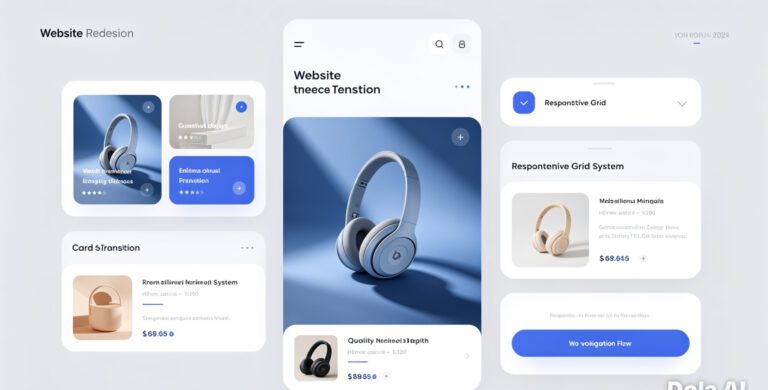
The pace at which website design is moving right now? Frankly, it’s wild. The tools we used five years ago seem prehistoric compared to what’s available in 2025. Static pages and complicated menus have given way to smart, user-centric experiences that barely resemble what most people called “web design” a decade ago.
Working with clients across Devon over the past year, I’ve seen firsthand how the design landscape is shifting. Businesses. From small artisan shops in Totnes to growing SaaS startups in Exeter. Are starting to treat design not just as decoration, but as strategy.
Here are seven innovations that are defining the future of web design in 2025… and why you need to care.
1. AI-Driven Interfaces Are Here to Stay
This isn’t science fiction anymore. From navigation that adapts in real time to conversational interfaces that feel eerily human, artificial intelligence is now woven into the very fabric of user experience.
Case in point: I helped redesign a property website earlier this year using a headless CMS and a machine learning-based recommendation engine. Instead of showing static listings, the site now learns from a visitor’s behavior and serves up custom suggestions. Like an estate agent with perfect memory.
What blew my mind? Bounce rates dropped by 38% within a month.
AI isn’t just about automation; it’s about intelligent interaction. Designers are collaborating with data scientists more than ever to craft experiences that feel personal without being invasive.
2. Immersive Experiences Redefine Engagement
Think fluid animations, spatial interfaces, and micro-interactions that respond with tactile smoothness. These aren’t gimmicks anymore. They’re expected.
WebGL and real-time 3D rendering are starting to blur the lines between websites and native apps. I recently tested a portfolio site built by a design student in Plymouth using Spline. Visitors could tilt and rotate a 3D model of their CV using just their cursor. It felt more like a game than a resume.
Why does this matter? Because people crave delight. And interaction is the new content.
3. Accessibility-First Layouts Are the New Standard
This shift might be the most meaningful (and overdue) one yet. In 2025, thinking about accessibility after launch is simply not acceptable. From semantic HTML to high contrast design and screen reader support, inclusion is baked in from day one.
The Web Content Accessibility Guidelines (WCAG 2.2), last updated in October 2023, are no longer just best practice. In many regions, they’re legal requirements.
A local café I worked with last winter made the choice to go accessibility-first. Not because it had to, but because it should. Not only did it expand their user base, but the redesign ended up performing better across the board: higher mobile performance scores, longer session duration, and stronger conversion from mobile.
Lesson learned? Designing for everyone helps everyone.
4. Ethical Design Takes Center Stage
Dark patterns are getting called out. Big tech has seen some major reckonings in the past 18 months (you probably remember the FTC case targeting misleading UX flows in late 2024). These changes have pushed design teams to ask one essential question:
Just because we can, should we?
Designers are being held accountable in new ways. Sites now need to be transparent about how they gather data, get consent, and guide users.
Trust has become just as important as utility.
If your site feels manipulative. Or even just ambiguous. You’re going to lose users fast. Start with empathy. Work with your legal team. Test every choice.
5. Responsive Design Is Growing Up (Again)
We’ve been talking about responsive design for over a decade, right? But 2025 has brought something better: adaptive design systems.
Not just scaling layouts to fit tablets and phones. But adapting content, behaviors, and functionality to different devices dynamically.
Tools like Container Queries and View Transitions (now fully supported in nearly every modern browser) are opening up new levels of finesse. A simple example: a media publication in Exeter saw a 22% increase in engagement after switching to an adaptive layout that reshuffled differently for foldable devices.
We’re designing for screen contexts now, not just screen sizes.
6. Personalised Micro-Content Is Powering Conversions
Forget generic landing pages. Sites are now assembling themselves differently depending on who’s knocking on the door. Geolocation, behavior history, even time of day. These factors shape what users see and how they interact.
One of our clients, a boutique hotel near Dartmoor, has been using dynamic content blocks tied to weather conditions. If rain’s forecasted? Special offer for their spa. Sunny skies? Promote the garden brunch menu. Subtle, but incredibly effective.
Tools like Segment and Optimizely make this much more doable today than even two years ago.
7. Devon Businesses Are Leading Quiet Design Revolutions
This might sound niche, but it’s true: Devon has become an unexpected hotspot for thoughtful, modern design. Maybe it’s the creativity that comes with being close to nature. Or maybe it’s the small-town entrepreneurial spirit.
Working with businesses here, I’ve noticed they’re willing to experiment. A nonprofit in Dartmouth recently launched a site powered entirely by open-source tech, including a super-lightweight static framework (Eleventy) for speed and sustainability.
Another in Sidmouth revamped their ecommerce checkout using ethical UX principles, resulting in a noticeable boost in returning customers.
These aren’t flashy London agencies or Silicon Valley unicorns. They’re local, focused companies doing honest, smart work.
It’s inspiring.
So, What Does 2025 Mean for You?
Here’s the real takeaway: the future of website design isn’t about chasing trends. It’s about building experiences that are human, resilient, and forward-ready.
If your site still feels like a brochure from 2012. Or if it’s full of unnecessary bells and whistles that serve no real purpose—2025 is a wake-up call.
The smartest players are investing in empathy-driven, tech-smart, ethically designed websites that serve users better than ever before. You don’t need a massive budget to follow their lead. You just need curiosity, thoughtful choices, and the right partners.
Curious how your site stacks up against today’s standards? I’m offering a no-pressure, 15-minute design audit for businesses and creatives who want honest feedback and actionable tips. Just shoot me a message.
Let’s make the web better. One pixel at a time.